The Hidden Epidemic: Why Smokeless Tobacco Is Harder to Quit Than Cigarettes
There are thousands of smoking cessation programs. Patches, gums, medications, apps, support groups, hotlines, hypnotherapists who specialize in it. The infrastructure is vast. For smokeless tobacco users? Almost nothing. You're expected to quit using tools designed for a completely different addiction. And when they don't work—when you've tried the nicotine patch and the willpower and the switching to sunflower seeds—you assume the problem is you. It's not.
ARTICLES
Guzalia Davis
The Invisible Addiction
Smokeless tobacco doesn't announce itself the way cigarettes do. There's no cough, no smell, no stepping outside in the cold. No one asks you to move away from the entrance. Your teeth might tell a story eventually, but for years, the addiction can remain essentially invisible.
This invisibility is part of the trap.
Because no one sees it, no one intervenes. Because it doesn't disrupt social situations, there's less external pressure to quit. Because it's not cigarettes — because it's "not as bad" — the urgency stays low until a dentist finds something concerning or a health scare makes it suddenly, terrifyingly real.
By then, the dependency has had years to entrench itself.
Why Cigarette Protocols Fail
Here's what most people don't understand, including many clinicians: smokeless tobacco is not the same addiction as cigarettes. It's not even close.
Yes, both involve nicotine. But that's where the similarity ends.
The delivery mechanism is different. Cigarettes create sharp spikes of nicotine; smokeless tobacco provides slow, sustained release. The withdrawal pattern is different. The triggers are different. The rituals are completely different.
A cigarette smoker steps outside, lights up, takes a break. It's tied to transitions, social moments, specific times of day.
A dip user has the substance in their mouth continuously. It's tied to everything — work, driving, watching TV, falling asleep. The oral fixation runs deeper. The integration into daily life is more complete.
Using smoking cessation protocols for smokeless tobacco is like using a map of Chicago to navigate New York. Same country, wrong city. You'll end up lost, and you'll blame yourself for not following the directions properly.
The Unique Architecture of This Dependency
In my clinical work with smokeless tobacco users, I've identified patterns that simply don't appear in cigarette addiction — or appear in entirely different forms.
The oral soothing pattern. For many users, the habit installed itself during adolescence as a form of self-regulation. The mouth is one of our earliest sources of comfort. Smokeless tobacco hijacks this deeply rooted soothing mechanism in ways that cigarettes don't. You're not just addicted to nicotine; you're addicted to a specific form of oral self-regulation that your nervous system now depends on.
Identity fusion. In certain professions, cultures, and regions, dip isn't just a habit — it's part of who you are. It's what the men in your family did. It's what everyone on the job site does. It's woven into your sense of belonging and identity. Quitting isn't just stopping a behavior; it feels like abandoning part of yourself.
The "not as bad" rationalization. This one is insidious. Because smokeless tobacco carries less social stigma than cigarettes, users can maintain the fiction that it's not a real problem. This delays action for years, sometimes decades—while the dependency deepens and the health risks accumulate silently.
The continuous-use pattern. Cigarette smokers have gaps between cigarettes. Smokeless tobacco users often have virtually no gaps. The substance is present for hours at a time, day after day. The nervous system never fully experiences being without it. This makes withdrawal more disorienting — you're not missing a habit, you're missing a constant companion.
The Treatment Gap
Most hypnotherapists, counselors, and addiction specialists have never been trained specifically on smokeless tobacco. They either turn these clients away or apply cigarette protocols and hope for the best.
I've seen the results of this approach: clients who've "tried hypnosis" and it "didn't work." What they actually tried was a smoking cessation session delivered by someone who didn't understand the fundamental differences in their addiction.
This gap is why I train hypnotherapists through my school to specialize in areas where few others have expertise. The people struggling with smokeless tobacco deserve practitioners who understand what they're actually dealing with — not generalists applying generic protocols.
What Resolution Actually Requires
Quitting smokeless tobacco requires an approach designed specifically for it:
Addressing the oral fixation at its root. Not just replacing the habit with something else, but working with the nervous system's need for oral soothing and developing genuine alternatives.
Disentangling identity from the habit. This is deep work. If being a dipper is part of how you see yourself, you need to construct a new self-concept that doesn't depend on the substance. Willpower can't do this. Subconscious restructuring can.
Preparing for continuous-absence withdrawal. The experience of not having something that was constantly present is disorienting in ways that cigarette quitters don't face. This needs to be anticipated and addressed specifically.
Working with the specific triggers. Not cigarette triggers — your triggers. The long drive. The work shift. The moments of boredom or stress that have been paired with dipping for years or decades.
A Note to Those Who've Failed Before
If you've tried to quit smokeless tobacco and failed — possibly multiple times — I want you to hear something clearly:
You did not fail because you're weak. You did not fail because you lack willpower. You did not fail because you're "not ready" or "don't want it enough."
You failed because you were using the wrong tools.
Smokeless tobacco dependency is a specific condition that requires a specific intervention. When you receive that intervention — when someone actually understands what they're working with — resolution becomes possible.
Not easy. But possible.
The Path Forward
I work with clients to resolve smokeless tobacco dependency at the subconscious level — not managing the craving, but eliminating its source. This requires understanding the full architecture of your particular dependency: when it installed, what function it's serving, what your nervous system believes it needs the substance for.
It also requires a practitioner who has seen this pattern hundreds of times and knows its variations. Not someone guessing based on cigarette protocols. Someone who has specialized in exactly this.
If you've been waiting to quit until you felt ready, you may be waiting forever. Readiness isn't a feeling that arrives — it's a decision that's made.
And if you've been telling yourself it's "not that bad" because it's not cigarettes, I'd invite you to reconsider. Your health doesn't grade on a curve. The risks are real, the dependency is real, and the time you've spent caught in this pattern is time you won't get back.
There is a way out. It just requires the right approach.
Your next step: C.L.E.A.N Tobacco Recovery Program
Prefer a Self-Guided Approach?
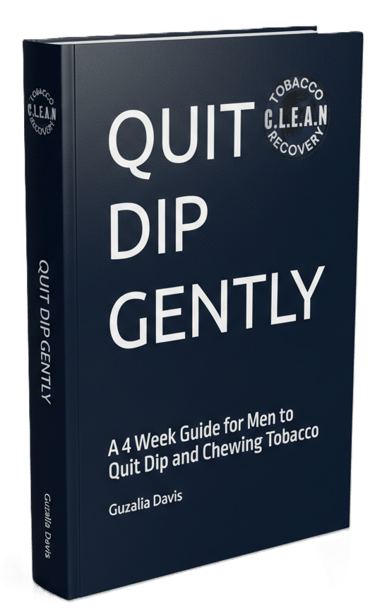
If you would rather work independently, I have also created a comprehensive, practitioner-grade guide for resolving nicotine dependency on your own. This book distills the same psychological principles, subconscious strategies, and behavioral restructuring methods I use in private sessions — adapted for self-guided application.
It is designed for individuals who:
Prefer to move at their own pace
Want privacy and flexibility
Are comfortable working independently
Appreciate structured, professional guidance
While private sessions offer personalization and real-time adaptation, many readers achieve meaningful results using this resource alone.
You are welcome to begin with the book, the private session, or a combination of both. There is no “right” path — only the one that fits your life and temperament.
© 2015 Guzalia Davis
Phone: 717 - 753 - 8845
Located in Pennsylvania, USA | Serving Clients Internationally [Terms of Service] [Privacy Policy] [Train with Me] [Testimonials]
Become a hypnotherapist


Quit smoking, vaping, dipping, or chewing tobacco.


Prepare your children for college (Social & Emotional Learning)
Youth Navigator™ Bootcamp